

OUR STORY
Where Ago and Ame come from
Before Ago and Ame belonged to Cleveland, they belonged to a classroom.
Picture a teacher calling a room of children to order: Ago, and the room answers back, Ame, without missing a beat. It's a ritual carried out of West Africa through the Twi language, passed forward through generations of the diaspora, and still taught to children today. Loosely, Ago asks for attention. Ame promises it's been given.
For Cleveland Parent Congress, that ritual isn't a slogan, it's a strategy. Ago is how you get a whole city's attention. Ame is what happens when the answer is real: not a nod, not a form letter, an actual room full of people who showed up because they meant it.
Ago
The call - I need your attention.
Ame
The response - we’re listening.
01 ━━ AGO ━━ THE CALL
Cleveland's parents have always known how to organize for their children.
That knowledge lives in the soul of this city, and long before Ago had an English translation in any proposal, Cleveland families were already living the practice, at Sunday dinner tables where the food was never really the point.
Around those tables, a family wasn't just eating together. It was practicing something. One debate over a sermon, one disagreement about the news, one argument about how a child had been treated at school, one conversation at a time, and somewhere in the middle of all that back and forth, a kid figured out they had a voice and that it was allowed to be used. That push and pull, the permission to disagree hard and still pass the plate afterward, was its own kind of democracy.
This isn't just a family story. Fifty years ago, when the courts finally ruled that Cleveland's schools were illegally segregated, it wasn't policy alone that forced change. Parents and guardians, standing together with their neighbors, became one of the most powerful forces this city had seen. That history is close enough to touch, and it is exactly the kind of power Ago is calling back.
02 ━━ AGO ━━ THE CALL
Parent organizing runs through our city's veins.
Cleveland's parent organizing didn't start with us, and it goes back further than most people know.
-
The School Fund Society opens schools for Black students in Cleveland when the state wouldn't.
-
Mothers gather at First Presbyterian Old Stone Church and found the Cleveland Congress of Mothers. The local group grew quickly, from 95 individual members in 1905 to 3,000 in 53 affiliated clubs in 1923. The congress promoted cooperation between parents and teachers in children's education, trained parenthood, and laws protective of children. It attacked juvenile delinquency and promoted teachers' pensions and education for the deaf and mute.
-
The Council of Parent-Teacher Associations counts 28,000 members across hundreds of clubs.
-
Reed v. Rhodes: the courts order Cleveland to desegregate its schools, driven by organized parents.
Then, starting in the 1970s, membership declined. Working parents, shifting neighborhoods, the upheaval of busing, the same forces that scatter any organizing tradition scattered this one too. The PTA never fully recovered, and nothing citywide and independent rose to take its place. That's the gap Cleveland Parent Congress exists to close.
Organized parent voice has shaped policy in this city before. We're picking the thread back up.
Source: Encyclopedia of Cleveland History, Case Western Reserve University
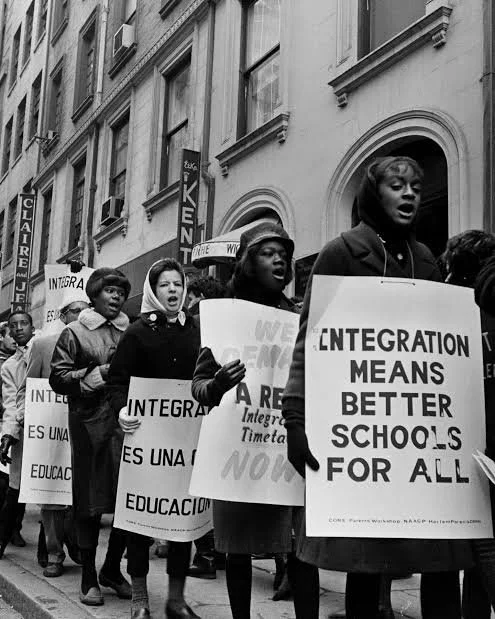
1976 answered a legal question. It didn't answer every question.
03 ━━ THE WEIGHT
Fifty years after Reed v. Rhodes, the ruling is history. The conditions it was meant to fix are not. Today in Cleveland, roughly one in two children grow up in poverty. Many carry the effects of lead exposure before they ever sit in a classroom. Neighborhoods are still shaped by decisions made decades ago, and families are still forced choosing among too few strong school options.
Here's what's also true: Cleveland still doesn't have what it arguably needed then and still needs now, an organized, independent governing and organizing body of parents that exists apart from any single school or district, meets regularly, and holds the system accountable to the families it's supposed to serve.
That's not a coincidence, and it's not something a workshop can fix on its own. It's the reason Cleveland Parent Congress exists. Ago is an active call because the alternative, staying quiet and waiting for the next report or ruling to handle it, has already been tried. We're done finding out what happens when nobody's at the table. We're coming back to it, for our children and for this city.
04 ━━ AME ━━ THE RESPONSE
Ame is not just an answer. It is a homecoming.
It says exactly what the word means: we're listening. Not later, not after the decision is already made. Now.
We carry knowledge no policy brief can hold: knowledge of our own children, our own blocks, our own families. Ame says we are here, we have always been ready, and we are ready to lead.
It's also rooted in something simple: every child in this city belongs to all of us. When we come back to the table, we come back for our own children, and for each other's.
The Cleveland Parent Congress is a citywide, independent parent initiative. Through a series of Town Halls, we bring Cleveland parents together across every kind of school this city has, with unbiased, nonpartisan information on how schools are governed, funded, and rated, real tools for supporting your child, and honest working relationships with educators.
The goal: organized parents with the standing to hold Cleveland's schools accountable to the families they serve.

05 ━━ WHAT WE BELIEVE
Parents already carry the knowledge this system needs.
-
We believe parents already carry the knowledge and expertise that Cleveland's education system needs.
-
We believe every parent deserves a dependable, consistent, and safe space — one where they are the priority.
-
We believe in a Cleveland where parents aren't the last audience consulted, but organized decision-makers with real standing.
-
We believe getting there starts small: one Town Hall, one conversation, one relationship at a time.